What If You Could Become an Organized Person?
If you've ever looked around your home and thought:
"I'm just not an organized person."
You're not alone.
In fact, it's one of the most common things I hear from clients before we begin working together.
They assume that organized people were simply born that way.
That they naturally enjoy color-coded closets, tidy pantries, and perfectly labeled bins.
But after helping hundreds of families create more functional homes, I've learned something important:
Organization is not a personality trait. It's a skill.
And like any skill, it can be learned.
Whether you're a busy professional mom, managing a household, working full-time, or simply feeling overwhelmed by clutter, the goal isn't perfection.
The goal is creating simple systems that make everyday life easier
The Biggest Myth About Organized People
Many people believe there are two types of people:
Organized people
Disorganized people
But that's simply not true.
Think about any other skill.
No one is born knowing how to:
Drive a car
Cook a meal
Use a computer
Manage finances
Organization works the same way.
The people who appear naturally organized have usually developed habits and systems over time.
What you're seeing isn't talent.
You're seeing practice.
Why Motivation Isn't the Answer
One of the biggest mistakes people make when trying to get organized is waiting until they feel motivated.
Motivation feels great.
Unfortunately, it doesn't last.
That's why so many organizing projects start with excitement and end with half-finished piles sitting on the floor.
The families who maintain organized homes don't rely on motivation.
They rely on systems.
Systems work when:
You're busy.
You're tired.
School is back in session.
Life gets chaotic.
A good system removes the need to constantly make decisions.
And fewer decisions mean less stress.
The 5 Skills That Create an Organized Home
The good news?
You don't need special talent.
You simply need a few practical organizing skills.
Skill #1: Make Decisions Faster
Most clutter isn't a storage problem.
It's a decision problem.
Items stay in our homes because we haven't decided:
Keep it?
Donate it?
Toss it?
Store it?
The longer decisions are delayed, the more clutter accumulates.
A simple question can help:
"Would I buy this again today?"
If the answer is no, it may be time to let it go.
Skill #2: Declutter Before You Organize
One of the most expensive mistakes homeowners make is buying containers before reducing what they own.
You can't organize excess.
You can only organize what you decide to keep.
Before purchasing bins, baskets, or organizers:
Remove trash.
Remove donations.
Remove duplicates.
Remove items you no longer use.
Then organize what remains.
Skill #3: Group Similar Items Together
Professional organizers call this categorizing.
Most cluttered homes have similar items scattered throughout multiple rooms.
Think about:
Batteries
Office supplies
Cleaning products
Children's art supplies
When similar items live together, you can:
Find things faster
Avoid duplicate purchases
Maintain systems more easily
Skill #4: Give Everything a Home
One of the simplest organizing rules is this:
Every item needs a designated home.
If something doesn't have a place to live, it will likely end up on:
Counters
Kitchen tables
Bedroom dressers
Floors
The easier an item is to put away, the more likely it will stay organized.
Function always beats perfection.
Skill #5: Practice Simple Maintenance
Organization isn't a one-time event.
It's a maintenance habit.
The good news?
Maintenance doesn't have to take hours.
Many of our clients maintain their systems with:
Small actions prevent overwhelming messes from returning.
How Professional Organizers Think Differently
When people see before-and-after photos, they often focus on the containers.
But containers aren't the secret.
Professional organizers focus on:
Function Before Beauty
A system that works is always more important than a system that looks pretty.
Convenience Before Perfection
If a system requires too much effort, it won't last.
Simplicity Before Complexity
The easiest systems are usually the most sustainable.
That's why we spend far more time creating workflows than shopping for products.
What Skill Should You Start With This Week?
If you're feeling overwhelmed, don't try to organize your entire house this weekend.
Instead, choose one small skill to practice.
You could:
Fill one donation bag.
Create a home for incoming mail.
Label one shelf.
Set up a simple landing zone.
Complete a 15-minute reset.
Small wins create momentum.
And momentum creates change.
You Don't Need More Willpower
If you've struggled to stay organized in the past, it doesn't mean you've failed.
It doesn't mean you're lazy.
And it certainly doesn't mean you're incapable.
Most people don't need more motivation.
They need a process.
The families who maintain organized homes aren't better than anyone else.
They've simply learned a few skills and built systems that support their everyday lives.
You can do the same.
Free Resource: Learn the 5 Skills That Build a Home That Stays Organized
Ready to take the next step?
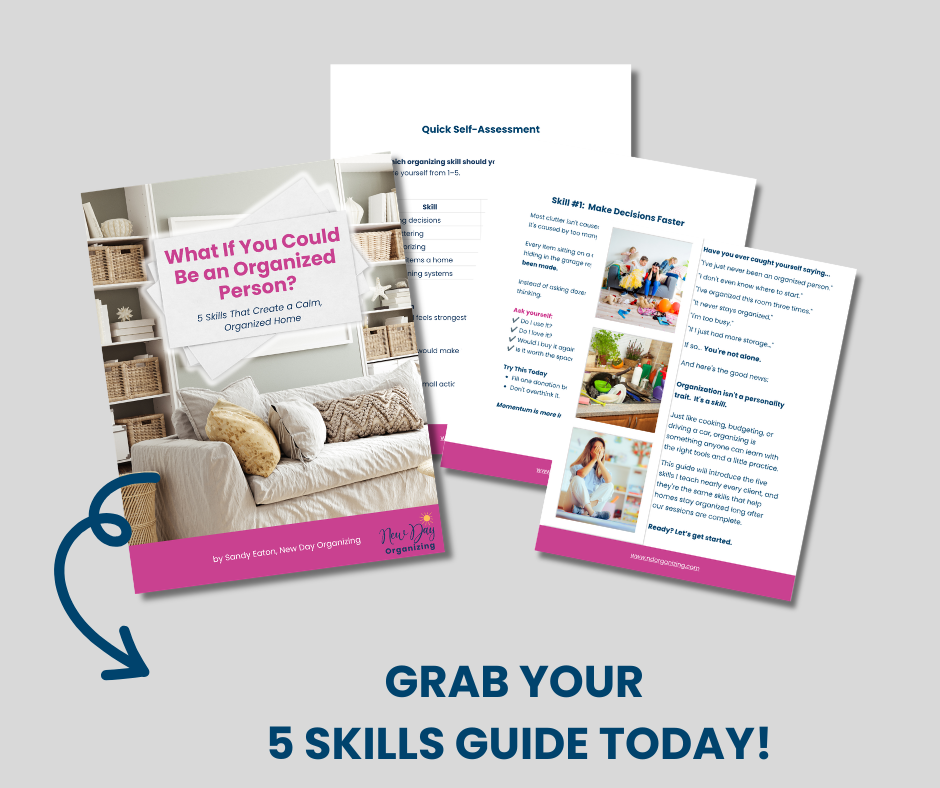
Inside you'll learn:
The skills professional organizers use every day
How to stop relying on motivation
Simple ways to reduce clutter faster
How to build systems that actually last
💛 Final Thought
If there's one thing I hope you remember, it's this:
You're not "just not an organized person."
Organization isn't a personality trait—it's a skill that anyone can learn.
You don't need more willpower, more time, or more organizing products. You simply need practical systems that fit your life.
So don't feel like you have to transform your entire home this weekend. Start with one drawer. One shelf. One donation bag. Small steps create momentum, and momentum creates lasting change.
At New Day Organizing, we believe organizing isn't about creating a picture-perfect home. It's about creating a home that feels peaceful, functional, and easy to enjoy.
Because when your home supports your life instead of adding to your stress, you can truly come home to peace, not another to-do list.
❓FAQ SECTION
Can anyone learn to be organized?
Absolutely. Organization isn't something you're born with, it's a skill that develops through simple habits and practical systems. While some people naturally enjoy tidying more than others, anyone can learn how to create an organized home that works for their lifestyle.
How do I get organized when I feel overwhelmed?
Start small. Instead of trying to organize your entire home, choose one drawer, one shelf, or one countertop. Completing a small project builds confidence and momentum, making it much easier to tackle larger spaces over time.
Should I buy organizing bins and containers before I start?
Usually, no. The first step is always to declutter and decide what you're keeping. Once you've reduced the amount of belongings you own, it's much easier to determine what storage solutions you actually need. Buying products too early often results in spending money on containers that don't fit your space or your needs.
When should I hire a professional organizer?
If you've organized the same spaces over and over without lasting success, it may be time to bring in a professional. A professional organizer doesn't just help you tidy up, we help you make decisions, create systems that fit your family's routines, and build organizing habits that are easier to maintain long after the project is complete.
About New Day Organizing
At New Day Organizing, we help busy professionals and families transform overwhelming spaces into calm, functional homes. Through practical decluttering, personalized organizing systems, and move management services, we create solutions that are easy to maintain and designed for real life. Our goal is simple: to help you come home to peace, not another to-do list.