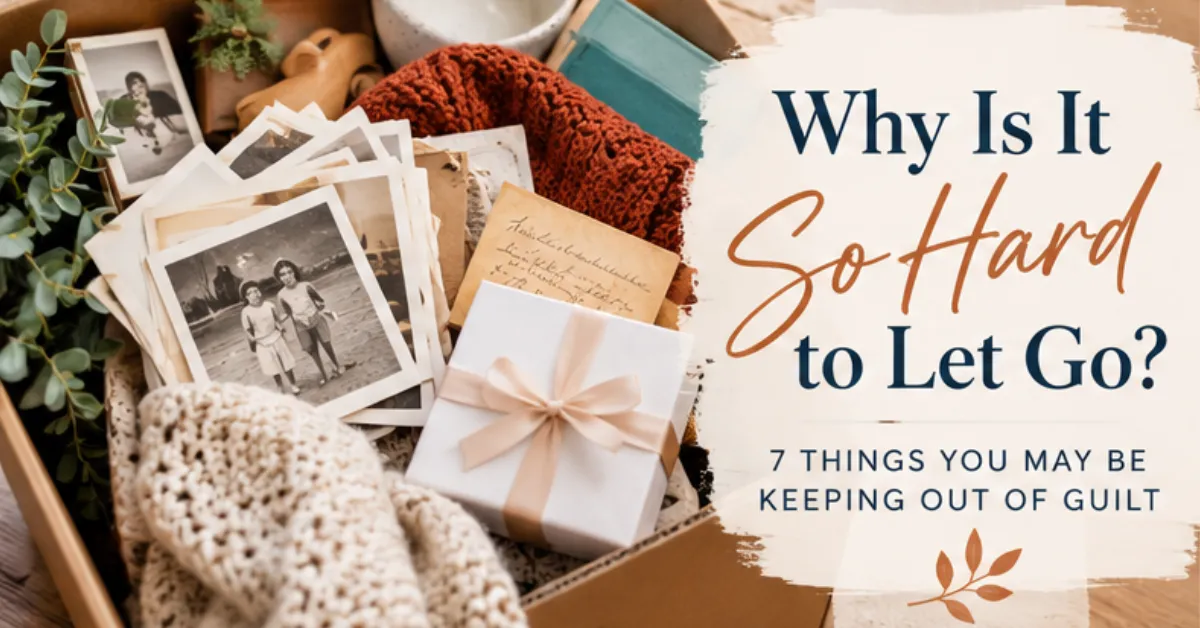
Is Your House Haunted by Clutter? 7 Things You May Be Keeping Out of Guilt
Is Your House Haunted by Clutter?
7 Things You May Be Keeping Out of Guilt
Have you ever picked up something while decluttering, known immediately that you don't use it anymore...and then put it right back?
Maybe it was a sweater someone gave you.
A kitchen appliance you spent way too much money on.
A box of your kids' old school projects.
Or supplies from a hobby you were definitely going to get back to someday.
You don't really want the item. You probably don't need it. But getting rid of it feels surprisingly hard.
If you've ever wondered why it's so hard to declutter your home, here's something important to understand:
Clutter isn't always an organizing problem.
Sometimes it's an emotional one.
Our belongings can become connected to memories, money, people, expectations and even previous versions of ourselves.
That means deciding what to keep and what to get rid of isn't always as simple as asking, "Do I use this?"
Sometimes the better question is: Why am I really keeping this?
If guilt, fear or obligation is the answer, these seven categories may be a great place to start.
1. Gifts You Don't Really Want
Let's start with one of the hardest categories to declutter: gifts.
Someone took the time to choose something for you. They spent money on it. Maybe it came from someone you love.
So getting rid of it feels...wrong.
Instead, it gets tucked into the back of a cabinet, pushed into a closet or packed into a storage bin.
Here's a different way to think about it:
Your relationship with the person is not contained in the object.
You can appreciate the thought behind a gift without committing to storing that gift forever.
If you're struggling with a gift, ask yourself:
If I hadn't received this as a gift, would I choose to bring it into my home today?
If the answer is no, that's useful information.
Someone gave you a gift because they wanted it to bring you happiness, not because they wanted it to become a lifelong storage obligation.
2. Things You Spent Good Money On
We've probably all said some version of this:
"I can't get rid of that! I paid $150 for it!"
Maybe it's an expensive pair of shoes that hurt your feet.
An exercise machine collecting laundry.
A kitchen gadget you used twice.
Or an organizing product that never actually worked for your space.
The money can make letting go especially difficult because getting rid of the item feels wasteful.
But keeping it doesn't bring the money back.
The money has already been spent whether the item stays in your closet for another five years or leaves your home tomorrow.
So instead of asking: "How much did I pay for this?"
Try asking: "Is this item valuable to my life now?"
If you're not using it, consider selling it, donating it or passing it along to someone who will.
You may not recover what you originally spent, but you can recover something valuable:
Space in your home.
3. Clothes for a Different Version of You
Clothing can carry a surprising amount of emotional weight.
There are the clothes you're going to fit into again someday.
The clothes you wore to an old job.
The outfit that represents a lifestyle you don't really live anymore.
The expensive dress you wore once.
And sometimes, an entire closet can slowly become filled with clothing for a version of yourself that existed five, ten or twenty years ago.
Try looking at your closet through the lens of the life you're living right now.
Ask:
Does this fit me today?
Is it comfortable?
Do I feel good wearing it?
Does it fit my current lifestyle?
Would I choose this if I were shopping today?
Your closet should make getting dressed easier—not remind you every morning of what you should wear, used to wear or hope to wear someday.
Keep the clothing that supports your life now.
4. Supplies From Hobbies You've Moved On From
Remember when you were going to scrapbook?
Make homemade candles?
Learn to knit?
Start painting?
Exercise every morning?
We often invest money and enthusiasm into a hobby—and then life changes.
But the supplies stay.
Getting rid of them can feel like admitting failure.
It isn't.
Interests change. Seasons of life change. Priorities change.
You don't have to continue storing the equipment for every hobby you've ever tried.
Ask yourself:
"If I suddenly had three free hours this weekend, would I actually choose to do this?"
If your answer is no, consider allowing those supplies to move on to someone who is excited to use them.
You aren't giving up.
You're simply acknowledging where your interests are today.
5. Things You Inherited
Inherited belongings can be among the most difficult things to declutter.
Furniture. China. Jewelry. Books. Collections. Photographs. Decorations.
These objects can feel different because getting rid of them can almost feel like getting rid of part of the person.
But memories and belongings aren't the same thing.
You don't need to keep everything someone owned in order to remember them.
Instead, consider choosing a smaller number of meaningful items that genuinely remind you of that person.
Maybe Grandma's entire china collection doesn't fit your life—but her favorite serving bowl does.
Maybe you don't need every box of your father's belongings—but his watch, handwritten recipe or favorite photograph means something to you.
Keeping fewer meaningful pieces can sometimes allow those special things to become more meaningful because they're no longer buried among dozens of items you felt obligated to keep.
Your home doesn't need to become a museum of everyone you've loved.
Keep what helps you remember them with joy.
6. Things You're Keeping "Just in Case"
"But what if I need it someday?"
This is one of the most common reasons clutter accumulates.
Extra cords.
Old electronics.
Duplicate kitchen tools.
Boxes.
Leftover project materials.
Extra furniture.
Clothing you haven't worn in years.
And yes—sometimes you could need something again.
The question is whether that possibility deserves permanent storage space in your home.
For inexpensive, easily replaceable items, ask yourself:
How difficult would this actually be to replace if I needed it?
If something could easily be borrowed, purchased inexpensively or replaced in a few minutes, storing it for years "just in case" may not make sense.
Current decluttering advice often recommends paying special attention to duplicates and easily replaceable items when you're trying to reduce "just in case" clutter.
Remember:
Your home has value, too.
Every shelf, drawer, cabinet and closet is valuable space.
You don't have to fill that space with things you're keeping for a future situation that may never happen.
7. Things You're Saving for Your Kids
This one comes up frequently when we're helping families declutter.
Baby clothes.
School projects.
Toys.
Books.
Sports equipment.
Furniture.
Childhood collections.
Sometimes parents have entire closets or attics filled with things they're saving because:
"The kids might want this someday."
And sometimes they will!
But sometimes...they won't.
Instead of making that decision for your adult children, ask them.
Give them a reasonable opportunity to choose what matters to them.
You might say:
"I'm going through some of the things I've saved from when you were growing up. Is there anything you'd really like me to keep for you?"
Their answer may surprise you.
The things that feel deeply sentimental to you aren't always the things that feel sentimental to them.
And that's okay.
You can keep a few things because you treasure them.
But you don't have to store an entire childhood because someone might want it someday.
A Simple Question That Can Make Decluttering Easier
The next time you're decluttering and find yourself unable to make a decision, stop asking only:
"Should I get rid of this?"
That's a surprisingly loaded question.
Instead, try this:
If I didn't already own this, would I choose to bring it into my home today?
That small change in perspective can reveal a lot.
You may realize:
"No. I'm only keeping it because it was expensive."
"I'm keeping it because someone gave it to me."
"I'm afraid I'll regret getting rid of it."
"I feel guilty."
"I've just never made the decision."
And suddenly, the decision becomes a little clearer.
You Don't Have to Declutter Your Whole House This Weekend
If your home feels cluttered, please don't read this article and decide you're going to tackle every closet, cabinet and storage area before Sunday night.
That's usually a recipe for feeling even more overwhelmed.
Instead, choose one category.
Set a timer for 15 minutes.
Find five things you no longer use, need or want.
That's it.
Starting small is a common recommendation for people wondering how to declutter when they feel overwhelmed, because smaller projects reduce the number of decisions you're asking yourself to make at once.
And five things leaving your home is still five fewer things taking up space.
Progress over perfection.
Decluttering Isn't About Having Less. It's About Making Room for What Matters.
I don't believe everyone needs a minimalist home.
I don't believe your counters need to be completely empty.
And I certainly don't believe you should get rid of things you genuinely love just because someone on the internet says they're "clutter."
The goal of decluttering is much simpler:
Make your home support the life you're actually living.
When your closets, cabinets, garage and storage spaces are packed with things you don't use, the things you do use become harder to find, harder to put away and harder to enjoy.
That's when clutter begins affecting the way your home functions.
So as you're deciding what stays and what goes, remember:
You can appreciate a gift and let it go.
You can acknowledge an expensive purchase was a mistake and let it go.
You can treasure a memory without keeping every object attached to it.
You can outgrow a hobby.
You can change.
And you can decide that the space something occupies in your home is more valuable than the item itself.
Ready for a Simple Place to Start?
I've created a free Clutter Cleanse: 7 Surprising Things to Let Go Of This Fall to help you put these ideas into action.
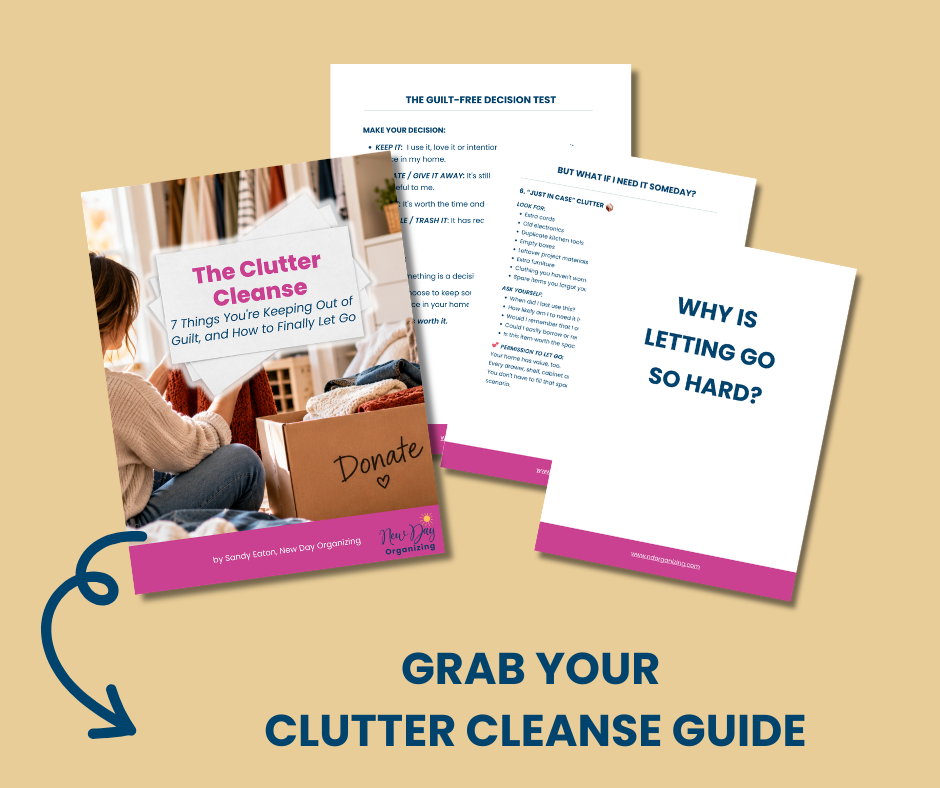
You'll walk through seven often-overlooked categories of clutter, simple questions to help you decide what stays and what goes, and a quick 15-minute challenge to help you start making progress without turning your entire house upside down.
Download your FREE Clutter Cleanse here.
And if you know what needs to change but don't have the time, energy or desire to tackle it alone, New Day Organizing can help.
We work alongside busy families throughout the Triad to declutter, organize and create practical systems that make everyday life easier.
Because the goal isn't a picture-perfect home.
It's a home that feels easier to live in.
💌 Want more decluttering tips like this?
Join my weekly email list for busy moms who want less chaos and more calm.